
Solutions For Healthcare
Pathology Reporting
Complete, Accurate and Research-Ready
Pathology reporting is most effective when the reporting protocol actively guides the data collection process. LogicNets enables pathology organizations, healthcare providers, and workflow vendors to transform reporting protocols into intelligent workflows that ensure complete, consistent, and research-ready data capture.
Whether based on in-house protocols or standards from organizations such as ICCR, CAP, and RCPA, LogicNets applications dynamically guide users through the reporting process, integrate with LIS, EHR, and registry systems, and generate structured outputs that support patient care, quality initiatives, population health, and clinical research.
Nationwide Structured Reporting Associated with Improved Outcomes
An article in the Journal of Clinical Oncology (ASCO) shows clear evidence of improved patient outcomes and survival as a direct result of using LogicNets-based Standardized Structured Reporting (SSR). The research looked at over 70 thousand colorectal cancer cases in the Netherlands, all SSR-implemented through nationwide use of the LogicNets platform by customer PALGA. The study credits measurable increases in completeness and accuracy of SSR-acquired patient data to significant improvements in adjuvant therapy administration and survival rates.
Essential Benefits

Improved Outcomes
Accurate and complete patient information, properly processed and fed directly into the workflow is a key to ensuring successful patient outcomes.

Increased Productivity
Dynamic, protocol-driven interaction minimizes unnecessary data entry and ensures the most relevant information is collected quickly and consistently.

Research-Ready Data
Protocol-driven data collection ensures that information is complete, standardized, and suitable for quality programs, registries, population health initiatives, and clinical research.

Population Health Enabled
Being able to consistently collect standardized, accurate, and complete data is the only way to support investment in registries and meet the massive potential of population health programs.
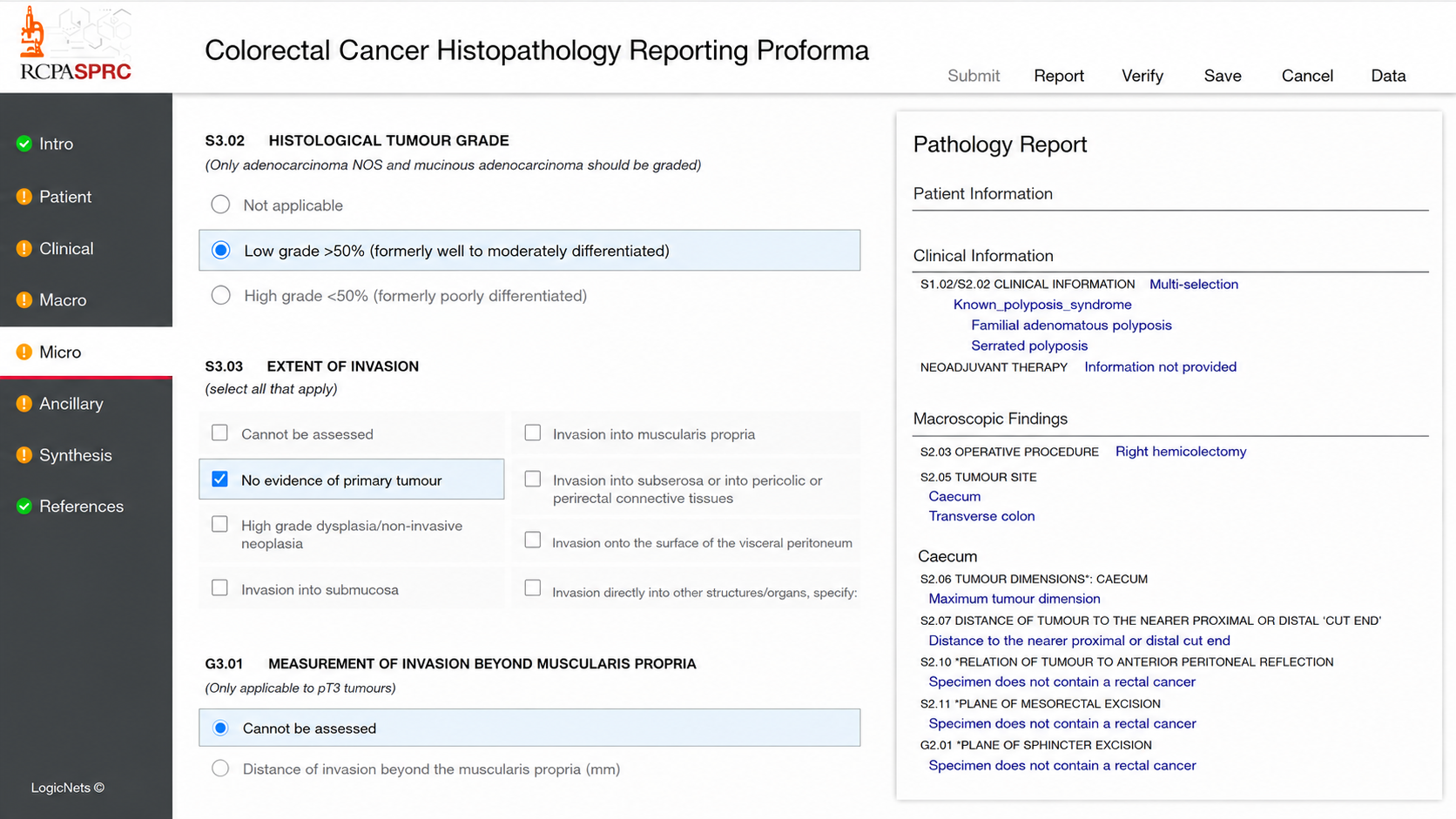
Synoptic Pathology Reporting Features
LogicNets transforms reporting protocols into intelligent workflows that dynamically and flexibly guide users to the most relevant questions, validations, and outputs based on the clinical context.
- Context and patient data integration — pre-populating patient and study data so there is no need for redundant data entry
- Dynamic and flexible input forms — clinicians navigate in any order; the form immediately rebuilds based on each input
- Context-aware guidance — maintain visual focus on a sample or image while speaking commands and dictating inputs
- Unlimited validation — applies any level of decision logic to dynamically validate inputs according to critical rules
- Mandatory answers and progress monitor — prevents reports from being submitted if mandatory questions have not been answered
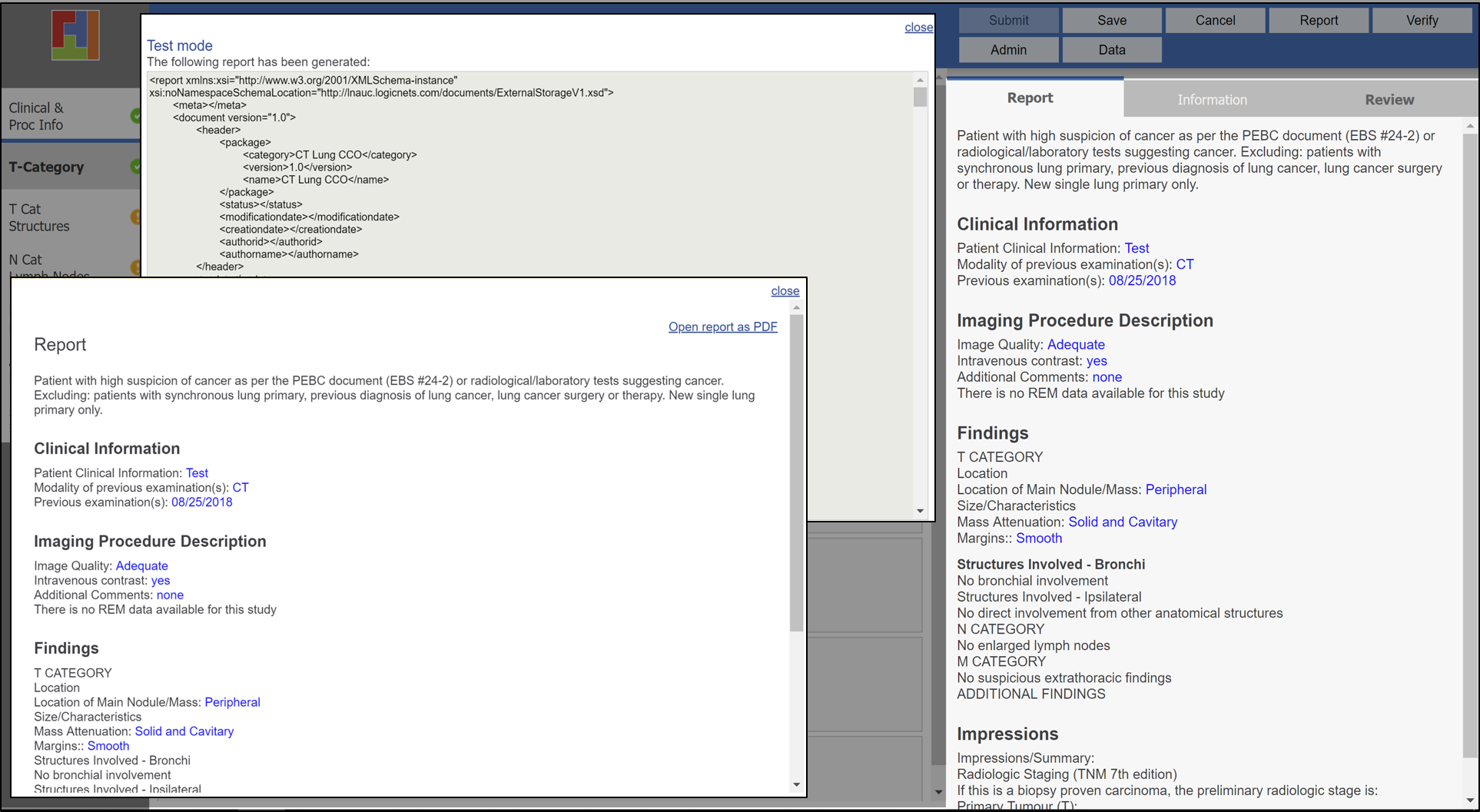
Dynamic Output & Documentation
- Flexible organization — reports organized into coherent groups using tabs and other layout controls
- Contextual reference information — training and help content displayed dynamically when complex questions require review
- Dynamic clinical summaries — protocol logic dynamically executes to generate on-screen summaries and computed results
- Calculators — automatically calculating and presenting derivative data such as TNM and cancer staging scores
- Structured data output — automatically generates interoperable data using healthcare informatics and exchange standards
- PDF reports — on-screen reports packaged as PDF files for download and distribution
Customer Success Story

Synoptic Reporting for Pathology
National Pathology Foundation of the Netherlands
PALGA is the national pathology foundation of the Netherlands. It is empowered by the Dutch national health system to provide a mandatory synoptic reporting application that is used by all pathologists in the country working out of approximately 50 regional pathology labs.
The LogicNets application uses PALGA-modeled decisioning to enable pathologists to efficiently capture critical reporting information and ensure accurate, complete report submissions. Within a year of deploying LogicNets and replacing prior systems, there was a clear improvement in user satisfaction ratings from pathologists, a major increase in reporting quality, and a significant boost to downstream pathology research.
An article in the Journal of Clinical Oncology (ASCO) shows clear evidence of improved patient outcomes and survival as a direct result of using LogicNets-based Standardized Structured Reporting (SSR). The research looked at over 70 thousand colorectal cancer cases in the Netherlands, all SSR-implemented through nationwide use of the LogicNets platform by customer PALGA. The study credits measurable increases in completeness and accuracy of SSR-acquired patient data to significant improvements in adjuvant therapy administration and survival rates.
Read the article ↗